


Choosing a JavaScript framework used to be a simple decision. For nearly a decade, React was the uncontested default for web application development. Choosing React meant guaranteed job security for engineers, an endless supply of open-source packages, and a straightforward hiring pipeline for managers.
That landscape looks noticeably different today. While React remains the market leader, the engineering conversations surrounding it have shifted. Out of the dozens of alternative UI libraries that emerged over the last decade, Vue and Svelte are the ones that truly stood the test of time.
Their widespread adoption has sparked a fresh wave of industry debate: Has React become overly complex with Server Components? Is Vue’s pragmatic approach simply easier to maintain? Does Svelte’s compile-time architecture offer unbeatable speed? Add the rapid rise of AI-assisted engineering into the mix, and framework selection becomes more nuanced than ever.
The Most Popular JavaScript Frameworks in 2026
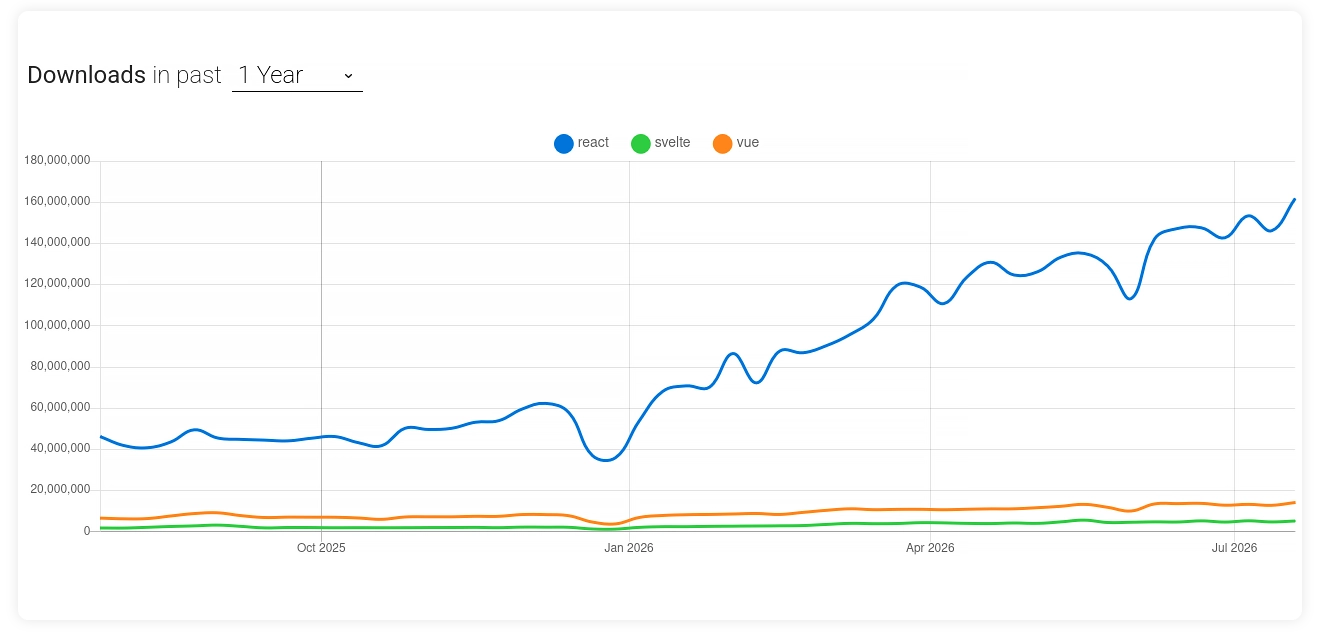
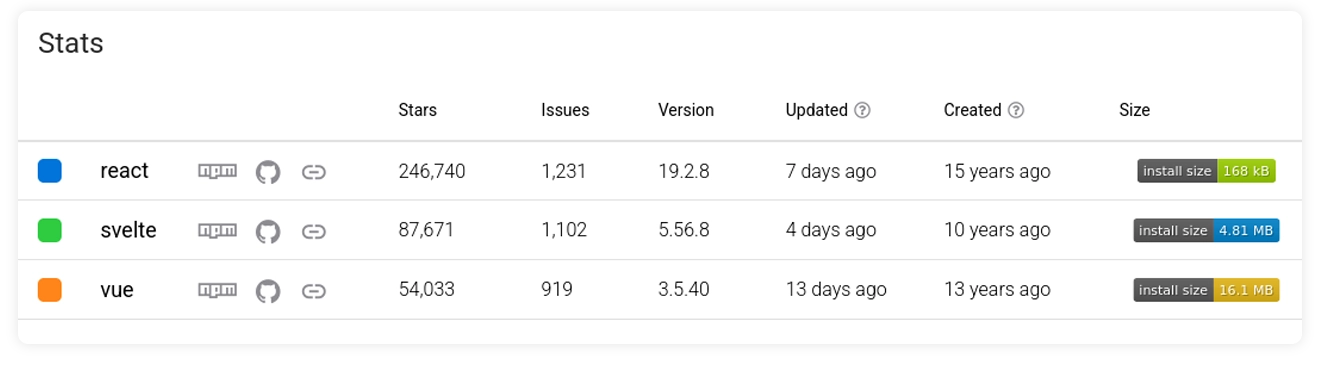
The numbers show that React dominates raw adoption, Vue maintains a strong middle position, and Svelte commands unmatched enthusiasm among developers.
Annual NPM downloads
Here are some stats from npm Trends:
The State of JavaScript 2025 survey data highlights key trends across ecosystem usage and developer perception:
- React: Roughly 85% of survey respondents actively use React.
- Vue.js: Vue holds second place in global usage at approximately 52%, a position it has maintained since overtaking Angular.
- Svelte: Around 27% of developers report using Svelte. However, it leads the industry in positive sentiment, ranking first in Developer Interest (63%) and overall Positivity (71%), while holding second place in user Satisfaction.
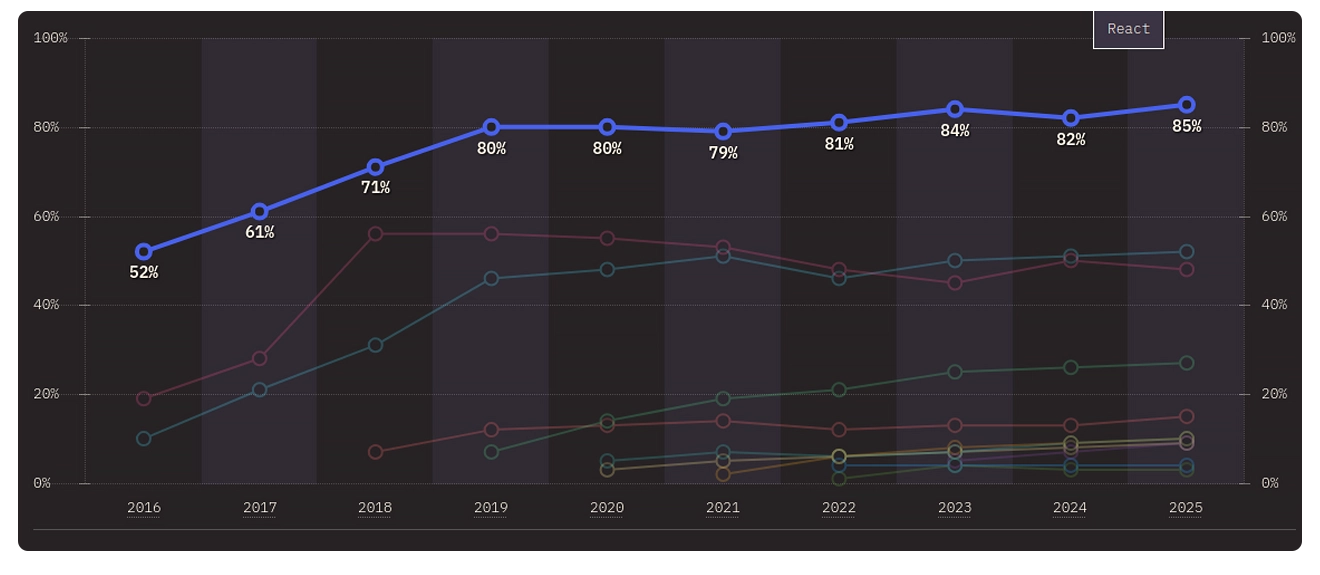
The numbers show that React is the undisputed industry standard. Vue provides an accessible, stable alternative with widespread global adoption. Svelte operates as a fast-growing challenger, loved by engineers.
| Metric | React | Vue.js | Svelte |
|---|---|---|---|
| Annual NPM Downloads | ~162.5M | ~14.1M | ~5.2M |
| GitHub Stars | ~247K | ~210K (Vue 3 / vuejs/core + legacy vuejs/vue) | ~87.7K |
| State of JS Usage | ~85% | ~52% | ~27% |
| State of JS Sentiment | Stable | High stability | #1 Interest (63%) & Positivity (71%) |
React vs Vue vs Svelte: Which One Should You Choose?
Evaluating a framework for a production application requires looking past theoretical benchmarks or popularity. Engineering teams must weigh practical trade-offs in learning curves, runtime performance, ecosystem breadth, AI tool support, and long-term governance. Let’s examine how React, Vue, and Svelte stack up across each of these critical areas.
Learning Curve and Developer Ergonomics
The initial speed at which an engineering team can write maintainable code varies considerably across all three options.
React relies on JSX and a functional component paradigm. React is a UI library rather than a full framework; it leaves routing, complex state management, and form handling to third-party decisions. Managing state requires hooks like useState or specialized state management stores like Redux, Zustand, and more. This design requires teams to establish strict architectural guidelines to keep code bases maintainable over time.
Vue uses Single File Components (.vue files), combining HTML templates, JavaScript logic, and scoped CSS into a single document. Developers transitioning from standard web development usually find this structure intuitive. Two-way data binding via v-model eliminates repetitive state handling code, making form-heavy applications fast to build.
Svelte takes simplicity further by staying as close to vanilla HTML, CSS, and JavaScript as possible. In Svelte 5, reactivity is managed through explicit primitives called Runes, such as $state() and $derived(). Variables act like standard JavaScript values, avoiding complex state setters or explicit dependency arrays.
💡 If you’re interested in how we migrated our SVAR Svelte component library to Svelte 5, we’ve shared our experience here.
Performance and Bundle Size Realities
React ships a shared virtual DOM runtime that must be loaded by the browser. Unoptimized React applications can see bundle sizes exceed 400 KB before accounting for custom business logic. Historically, keeping React applications performant required manual optimization. The release of the React Compiler in React 19 automates component memoization at build time, reducing unnecessary re-renders without manual code interventions.
Vue historically relied on a virtual DOM reconciliation process similar to React. However, Vue introduced Vapor Mode, an opt-in compilation strategy that bypasses the virtual DOM entirely to target direct DOM updates. This brings Vue’s execution speed into the same range as Svelte while preserving Vue’s existing developer experience.
Svelte compiles components into direct DOM manipulation instructions at build time. Because it ships without a virtual DOM runtime, initial JavaScript bundle sizes remain minimal. In production tests, equivalent applications built in Svelte frequently ship bundle sizes under 35 KB gzipped, making it an excellent choice for mobile-first software or environments with bandwidth limitations.
Gzipped production bundle comparison for an experimental SaaS rebuild in React, Vue, and Svelte:
- React: 148 KB
- Vue: 94 KB
- Svelte: 31 KB
Ecosystem Maturity and Tooling
React possesses the largest ecosystem. Whether a project requires high-performance virtualized tables, accessible component primitives, or complex chart engines, multiple mature packages exist for almost every requirement. However, this sheer volume of choices can lead to decision fatigue and fragmented choices across different internal teams.
Vue, rather than forcing developers to evaluate dozens of third-party options, provides official solutions for routing (Vue Router) and state management (Pinia), alongside deeply integrated ecosystem standards like Nuxt for full-stack rendering and Vite for build tooling.
Svelte includes built-in solutions for CSS scoping, UI transitions, animations, and basic state management. This out-of-the-box feature set reduces third-party dependency creep. However, Svelte’s total package count remains considerably smaller than React’s or Vue’s. For specialized enterprise UI features, teams choosing Svelte may occasionally need to write custom implementations.
AI Coding Support and AI Toolchain Integration
React holds a distinct advantage in AI-driven workflows:
- Training Data Volume: React powers roughly 30 million public projects. Large language models generate React code with higher accuracy, fewer hallucinated APIs, and better handling of complex edge cases.
- Dedicated AI Platforms: Popular prompt-to-UI platforms like v0 and Lovable generate React code by default. Specialized AI user interface kits, such as assistant-ui for building chat interfaces and the Vercel AI SDK, target React as their primary integration surface.
Vue and Svelte are taking active steps to bridge this gap:
- Svelte’s AI Push: Svelte’s maintainers introduced the Svelte Model Context Protocol (MCP) tool. This integration feeds framework-specific guidelines directly to AI agents, helping models understand Svelte 5’s Runes syntax accurately.
- Vue’s Ecosystem Positioning: While multi-framework environments like Bolt.new support Vue, there are currently fewer dedicated prompt-to-app code generation engines built specifically around Vue. However, Vue’s consistent API patterns make it relatively easy for general-purpose AI assistants to write reliable code once supplied with proper context.
Long-Term Governance and Enterprise Stability
React completed a major governance transition by moving under the React Foundation, hosted by the Linux Foundation. With founding platinum sponsors including Amazon, Microsoft, Meta, Huawei, and Vercel, React’s intellectual property and trademarks operate under neutral governance similar to Kubernetes and Node.js. This structure gives enterprise risk-assessors high confidence in React’s long-term future.
Vue operates as an independent, community-driven project led by Evan You. It is funded primarily through corporate sponsorships and crowdfunding, proving its resilience over more than a decade of stable releases.
Svelte operates under strong community leadership with backing from Vercel, where creator Rich Harris works. While Svelte has matured rapidly, major architectural updates like the transition to Runes demonstrate that its API surface is still actively evolving. For highly conservative enterprise organizations, this ongoing evolution can occasionally prompt cautious evaluation.
Developer Community Perceptions
Analyzing discussions across developer communities (such as Reddit’s r/reactjs, r/vuejs, and r/sveltejs) reveals clear, consistent perspectives on each tool:
React:
- Strengths: Unmatched career opportunities, dominant hiring pool, unmatched AI tooling compatibility, and an exhaustive package ecosystem.
- Criticisms: Growing architectural complexity, friction surrounding Server Components and Next.js App Router conventions, and persistent re-render debugging.
Vue.js:
- Strengths: Widely praised for clear documentation, gentle learning curve, cohesive core tooling, and stable developer experience.
- Criticisms: Smaller job market in Western enterprise hubs relative to React, and a more limited selection of specialized third-party component libraries.
Svelte:
- Strengths: High user satisfaction, clean syntax without virtual DOM overhead, impressive runtime speed, and lightweight bundle sizes.
- Criticisms: Cautious enterprise adoption, smaller talent pool, and a smaller library ecosystem that can require building custom components.
React vs Vue vs Svelte: A Practical Comparison
After analyzing each framework’s adoption, community sentiment, technical traits, and governance models, here’s the high-level summary of our comparison.
| Dimension | React | Vue.js | Svelte |
|---|---|---|---|
| Learning Curve | Moderate-High: JSX, hook rules, state boilerplate | Low-Moderate: Intuitive HTML/CSS templates, v-model | Lowest: Close to vanilla JS/HTML, intuitive Runes |
| Performance & Bundles | High Performance. Virtual DOM; ~148 KB avg bundle; auto-memoized in v19 | Balanced & Hybrid. Virtual DOM/Vapor Mode; ~94 KB avg bundle | Peak Performance: Direct DOM, no VDOM; ~31 KB avg bundle |
| Ecosystem Maturity | Unmatched depth, massive choice, risk of fatigue | Cohesive & curated official tools (Router, Pinia) | Lightweight out-of-the-box, fewer 3rd-party widgets |
| AI Tools Support | Gold standard (Largest training data, v0, Lovable) | Solid general AI support, fewer dedicated tools | Fast-growing (Svelte MCP tool), highly token-efficient |
| Governance | React Foundation, hosted by the Linux Foundation | Independent, community-driven & crowd-funded | Community-led with strong Vercel sponsorship |
| Primary Advantage | Market dominance & ecosystem depth | Exceptional docs & cohesive design | Top developer experience & tiny bundles |
| Main Challenge | Architectural complexity & setup fragmentation | Moderate Western enterprise job volume | Lower enterprise adoption & ecosystem |
These technical characteristics, ecosystem realities, and governance models directly influence which tool fits a given scenario. Here is a breakdown of the ideal use cases for each framework:
Best Use Cases for React:
- Enterprise SaaS platforms requiring deep long-term ecosystem stability and easy developer recruitment.
- Teams that rely heavily on AI generation platforms (v0, Lovable, Cursor) and specialized AI chat interfaces.
- Cross-platform web and mobile applications leveraging React Native shared patterns.
Best Use Cases for Vue:
- Mid-sized SaaS applications looking to balance development speed with clean maintainability.
- Projects requiring rapid team onboarding across developers with varying experience levels.
- Applications where official, cohesive core tooling (routing, state management) is preferred over custom setup decisions.
Best Use Cases for Svelte:
- Performance-critical web applications where minimal bundle size directly affects user conversion.
- Mobile-first web software targeting users on slow network connections.
- Product teams looking for high developer velocity with minimal framework boilerplate.
Choosing UI Enterprise-Ready Components That Work Across Frameworks
Regardless of whether an engineering team selects React, Vue, or Svelte, another architectural decision remains: choosing a UI component library. Committing entirely to a single framework’s UI library can create vendor lock-in, making future stack migrations or multi-app design system maintenance difficult.
One practical strategy is adopting UI component suites that provide identical functionality across multiple stacks. SVAR UI offers framework-native components for React, Vue, and Svelte that share a unified design and API. This approach allows organizations to:
- Maintain consistent UI behavior across different products and teams.
- Simplify long-term maintenance by reducing the need for custom, framework-specific implementations.
- Execute gradual stack migrations (e.g., moving from Vue to React) without rebuilding complex interface elements from scratch.

How SVAR Contributes to Each Ecosystem
SVAR React provides modern, TypeScript-first components that serve as leaner, framework-native alternatives to older, framework-agnostic JavaScript libraries often used in React projects.
SVAR Vue fills the gap for specialized enterprise components in the Vue ecosystem by offering native Composition API implementations that match the quality and depth typically found in React libraries.
SVAR Svelte addresses the scarcity of enterprise-grade UI in the Svelte ecosystem by providing complex components like Gantt and DataGrid written natively in Svelte 5, demonstrating how Runes and compile-time architecture can power serious business applications.
Conclusion: Choosing the Best JavaScript Framework in 2026
In 2026, there is no single “best framework.” Selecting a modern JS framework is a strategic evaluation of ecosystem depth, hiring availability, team velocity, and long-term maintenance costs rather than raw performance benchmarks. For most real-world applications, minor Svelte vs React vs Vue performance differences matter far less than development speed and support overhead.
Furthermore, most business applications face the same core challenge regardless of stack: delivering complex, reliable user interfaces. As a result, choosing the right UI component ecosystem is often just as critical as the framework itself.
Ultimately, among the best JS frameworks available today, your choice in React vs Svelte vs Vue should reflect your team’s constraints, hiring pipeline, and long-term business goals. Adopting native cross-framework toolkits like SVAR UI gives engineering teams a distinct advantage: maintaining a unified UX, reusing developer knowledge across teams, and enabling stack migrations without rebuilding complex UI elements from scratch.