


For a long time, React state management was dominated by a single monolithic global store approach proposed by Redux. Developers funneled server caches and transient UI flags into one object, accepting this as the default approach to how to manage state in React.
At some point, engineers realized that forcing a single pattern onto vastly different data lifecycles was an architectural bottleneck, which triggered an evolutionary explosion of specialized React state management libraries.
Instead of fighting over feature checklists of available Redux alternatives, we need to recognize this as a clash of philosophies. Modern frontends are moving away from the “single source of truth” toward specialized solutions ranging from centralized ledgers to reactive proxy objects, atomic nodes, and finite state machines.
In this landscape, choosing based purely on what’s popular on GitHub is a path to architectural failure. Today, we’ll dissect four major paradigms to explore their engineering mindsets and trade-offs.
From One Global Store to Multiple State Management Approaches
React provides several native state management mechanisms, such as useState, useReducer, and Context, which are sufficient for many applications. Yet they come with limitations. Context, for instance, causes unnecessary re-renders because any update to the context value forces all consumers to re-render, even if they only need a subset. You can patch this with memoization or splitting contexts, but that often leads to reinventing the wheel.
Here’s what React’s built-ins usually cannot handle cleanly: a frequently changing value, many components across the tree reading different slices, and each component should re-render only for its own slice. Redux stepped in with a solution — a single centralized store, explicit actions and reducers, and time-travel debugging. It brought predictability and structure, though it also gained a reputation for boilerplate.
Later, Redux Toolkit addressed this issue, reducing the clutter. However, the prejudice remained in the community. As the main Redux maintainer Mark Erikson pointed out:
But even as RTK streamlined the monolithic approach, the ecosystem kept moving, and the shift was toward specialization as developers started asking: why use one approach for everything? As the State of React 2025 survey showed, Zustand ranks as the second most popular state management library after a more mature Redux/RTK duo.
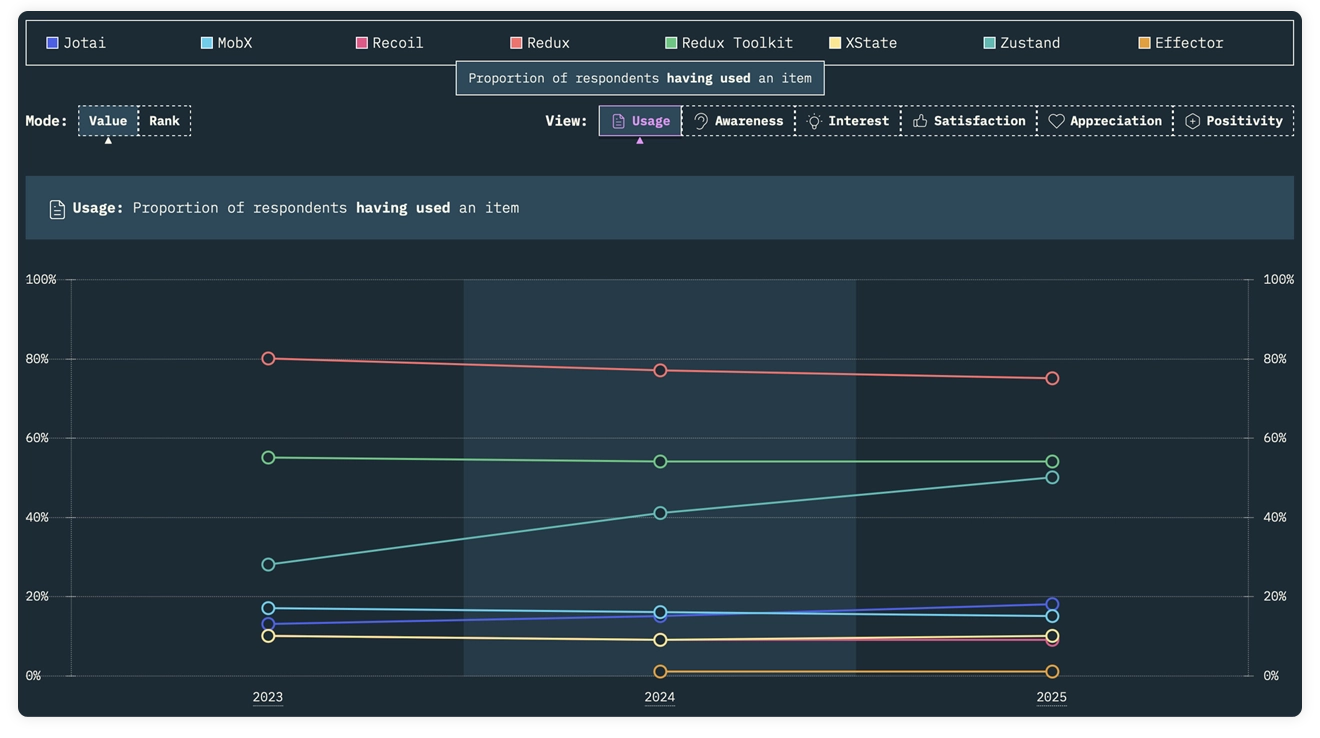
In terms of interest from developers, this rating has its own champions besides Zustand. For example, XState and Jotai each embody a different philosophy about what state is and how it should be managed. Let’s map out four main cognitive territories.
Different Philosophies of React State Management
We’ll consider four React state management approaches, each with a radically different mental model:
| Approach | How It Works | Examples |
|---|---|---|
| Centralized stores | Treat application state as a single, authoritative database | Redux/RTK, Zustand |
| Reactive systems | You mutate proxies directly, and the library handles derivation and propagation under the hood | MobX, Valtio |
| Atomic state management | Breaks the global store into independent particles | Jotai |
| State machines | UI exists in exactly one predefined state at a time, and transitions follow a defined graph | XState |
A robust React state management architecture no longer assumes one global store for everything. The pragmatic state management patterns in React often mix these paradigms, choosing the right philosophy for the right slice of the application.
Centralized Stores: Redux and Zustand
The centralized store philosophy treats your application like a single authoritative source of truth. This mental model dominated React state management for years, and two libraries now represent the spectrum of how far you can take it.
🔹 Redux and RTK
Redux is a React state management library that practically defined the pattern. The application state lives in one global store. Components never write directly to it. Instead, they dispatch actions — plain objects that describe what happened. Reducer functions interpret those actions and compute the new state. Selectors pick specific data slices for components, ensuring they only re-render when the data they watch changes.
Redux Toolkit wraps the original architecture with sensible defaults: slices that consolidate reducer logic and action creators, Immer for immutable updates that read like mutable code, and RTK Query for asynchronous data fetching.
Advantages: Exceptional devtools with time-travel debugging. Enforces a clear structure that pays back in maintenance hours.
Limitations: Still demands more code than alternatives, even with Toolkit. Steeper learning curve (actions, reducers, dispatching). Feels heavy for small teams or rapid prototyping.
When to choose Redux: Large-scale applications with complex state, multiple teams contributing, and a need for rigorous debugging, audit trails, and traceability across dozens of user interactions over time.
🔹 Zustand

Zustand, a lightweight React state management library, offers the same centralized philosophy but strips away the formalism. Instead of reducers and actions, Zustand stores contain both state and the functions that update it.
You create a store with create. You define update functions using a set method. Components call those functions directly without dispatch, action constants, or reducers to maintain. The entire store hook returns both data and updaters, eliminating the split between useSelector and useDispatch.
Advantages: Minimal boilerplate. Store lives outside React Context, avoiding cascade re-renders. Tiny bundle size. Direct, intuitive API.
Limitations: Less enforced structure; flexibility can become a liability on large teams. Managing multiple stores across large apps may require extra coordination.
When to choose Zustand: Medium-sized projects, rapid development cycles, or any application where simplicity and developer velocity outweigh strict architectural constraints.
Reactive Stores: MobX and Valtio
In Redux or Zustand, you write selectors to specify which properties a component needs. Components re-render only when the selected value changes. But selectors must be manually defined, and it’s easy to write ones that accidentally trigger more re-renders than intended.
Unlike centralized stores, reactive libraries automatically track which parts of the state components use. They track dependencies through JavaScript Proxies and update the UI when data changes. You mutate plain objects directly. React re-renders exactly where needed.
🔹 MobX
MobX is a mature React state management library that implements “observables”: data models that components could observe and react to individually. MobX takes a class-based, object-oriented approach.
You define your store as a JavaScript class, marking properties as observables and methods as actions using makeAutoObservable in the constructor. Methods mutate state directly — pushing to arrays, assigning to properties — while MobX handles tracking behind the scenes. Components connect through the observer wrapper, which automatically tracks which observables they use and triggers re-renders only when those specific values change.
Advantages: Automatic dependency tracking with no manual selectors or memoization. Direct mutation syntax — write code that looks mutable, and MobX keeps it in sync. Exceptional performance for deeply nested, graph-like data. Decouples complex business logic from the React view layer.
Limitations: Requires understanding of reactive approach and observables. Less explicit data flow compared to Redux, which can make debugging harder in large teams. The class-based approach may feel less natural for teams using a purely functional React style.
When to choose MobX: Teams that already think in classes and OOP, or projects with complex, deeply nested domain models where transparent reactivity simplifies logic. Also a strong fit for MVVM-style architectures where business logic needs to stay decoupled from the UI.
🔹 Valtio
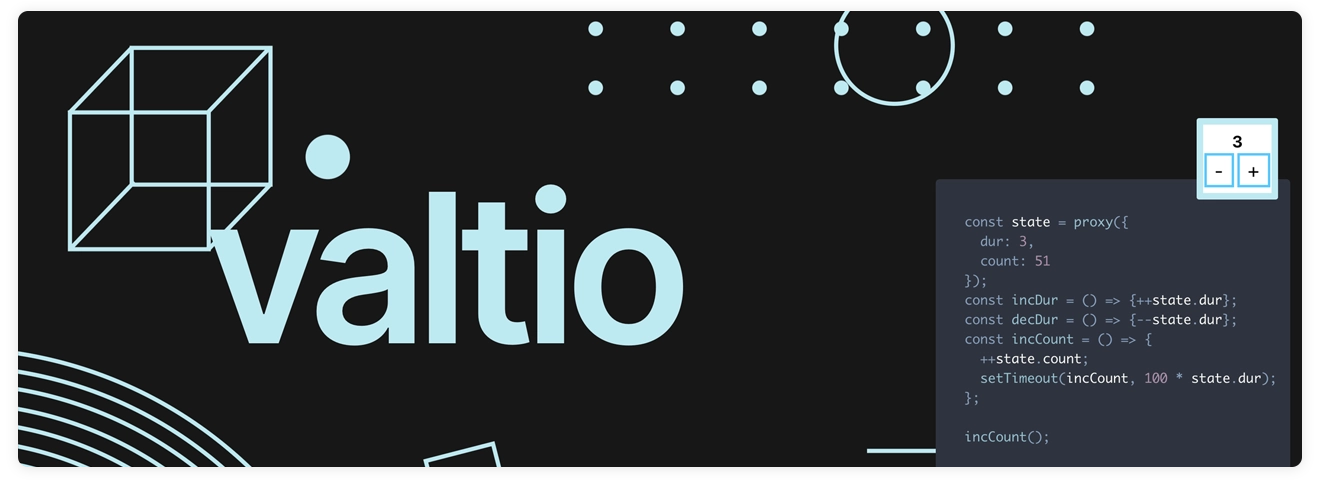
Valtio, a minimalist React state management library, offers the same proxy-based reactivity but strips away the OOP formalism. It wraps plain JavaScript objects in Proxies. You mutate state directly, for example via userStore.data = newData, and Valtio tracks changes automatically. Components read state through the useSnapshot hook, which subscribes to specific properties and re-renders only when they change.
Advantages: Minimal API. Direct mutation syntax feels natural and reduces boilerplate. Hooks-based integration fits modern React patterns. No classes, decorators, or complex setup.
Limitations: Mutating snapshots directly instead of the proxy state throws runtime errors. Pitfalls around re-assigning objects and dereferencing properties. Less suitable for state that needs to cross worker boundaries. Reactive model can still surprise developers new to Proxies.
When to choose Valtio: Rapid prototyping and applications with deeply nested, frequently mutated UI state — such as editors, design tools, real-time dashboards. If you want reactive updates without the OOP overhead of MobX, Valtio hits the sweet spot.
Atomic State: Jotai
The atomic philosophy treats your application like a constellation of independent particles. Instead of maintaining a single monolithic tree, state is split into many tiny, isolated values (atoms) that can be dynamically composed and connected.
🔹 Jotai
Jotai is a flexible React state management library that takes a bottom-up approach. Primitive atoms can hold anything — booleans, numbers, strings, objects, or arrays. Derived atoms read from other atoms before returning their own value, creating a dependency graph that updates automatically when sources change. Components access atoms through useAtom for read-write, useAtomValue for read-only, or useSetAtom for write-only access.
Jotai solves extra re-render issues. Since atoms are independent, a component reading atomA never learns about changes to atomB. The atomic model avoids the need for memoization and selector functions entirely.
Advantages: Granular re-renders. Atoms work without wrapping your app in providers (Provider-less mode). Minimal core API. Derived atoms compose naturally, allowing you to build complex state from simple pieces.
Limitations: Thinking in decoupled particles instead of a single store takes getting used to. Since there is no centralized dispatch pipeline or global action log out of the box, tracing the flow of complex multi-step transactions across multiple independent atoms can be challenging without custom wrappers.
When to choose Jotai: Interactive applications with complex UI where avoiding unnecessary re-renders is critical — dashboards, visual editors, Figma-like tools.
State Machines: XState
In this paradigm, your app is always in exactly one predefined status, and transitions happen only along permitted rails. If a transition is not explicitly defined for the current state, the machine ignores the event.
🔹 XState
XState, a state machine and statechart library for JavaScript, describes what states exist, what transitions are allowed, and what actions are permitted in each state. For example: Draft → Review → Approved → Published. The machine ensures that your UI cannot drift into undefined or contradictory configurations.
XState works by creating a machine with createMachine, where you define an initial state, possible states, events, and transitions between them. A submit event might move a form from idle to submitting to success.
The machine can also store additional context — such as counters, timers, or other workflow data. In React, components connect to this machine through the useMachine hook, which provides the current state and a send function for triggering defined transitions. This keeps transition logic inside the machine rather than inside React components.
Advantages: Makes complex multi-step processes explicit and visualizable. Automatic guardrails for flows like checkouts, wizards, or authentication. Events that are invalid for the current state are safely ignored. Supports hierarchical and parallel states for even more complex logic. Excellent tooling with visualizers and time-travel debugging for statecharts.
Limitations: Steeper learning curve. Overkill for simple CRUD apps or forms with only a couple of states. Boilerplate can be heavier than simpler solutions for trivial use cases. Integration with server state and side effects requires additional patterns.
When to choose XState: Complex, multi-step workflows where bugs in transition logic are expensive. Think checkout flows, 5-step registration, game logic, or complex dashboards where a user must follow a strict path. Also ideal when you need to visualize and audit every possible state transition.
Comparison Overview
This React state management comparison shows how different libraries solve different application requirements.
| Library | Philosophy | Main strength | Best fit |
|---|---|---|---|
| Redux | Centralized store with predictable state updates | Predictability, time-travel debugging, explicit data flow | Enterprise applications with complex state and multiple teams |
| Zustand | Lightweight centralized store with minimal ceremony | Simplicity, tiny bundle size, direct API | Medium-sized projects and rapid development cycles |
| MobX | Reactive state with automatic dependency tracking | Complex, deeply nested graph-like data models | Data-heavy apps and teams familiar with OOP/observables |
| Valtio | Proxy-based reactive state with a simple mutable API | Simple reactivity, direct mutation syntax | Lightweight applications with high-frequency UI mutations |
| Jotai | Atomic state with independent particles | Flexible composition, granular re-renders | Complex UI with dashboards, visual editors, Figma-like tools |
| XState | State machines with explicit transitions and guardrails | Explicit workflows, controlled state transitions | Process-heavy applications with multi-step flows |
React State Management with SVAR React Gantt
Complex UI components usually sit inside applications with different state architectures. Take a Gantt chart — it manages tasks, dependencies, item selection, inline editing, filters, user interactions, undo/redo, and often real-time collaboration. Forcing a component like this into a single state management paradigm would lock its users into an architecture they did not choose.
This is why the SVAR React Gantt component ships with dedicated integration guides for every major state management approach covered in this article:
- Redux integration
- Zustand integration
- MobX integration
- Valtio integration
- Jotai integration
- XState integration
Conclusion
Modern React state management reflects the ecosystem’s maturity. Redux remains a vital tool, but it is no longer the only answer. The emergence of new React state management solutions shows that the community has learned that state itself must be treated differently in various cases.
Explore our integration guides to see how SVAR enterprise React components such as SVAR Gantt React work with popular state management libraries. The right approach combined with the right components allows developers to integrate complex UI components into existing application architectures without changing their state management approach.